- Equity Mates
- Posts
- 📈 Treasurer warns of inflation spike | Rio Tinto secures $2bn bailout
📈 Treasurer warns of inflation spike | Rio Tinto secures $2bn bailout
Here's what you need to know today

Today’s News
The Big Picture

Chalmers warns inflation could spike again. Treasurer Jim Chalmers says inflation may climb as high as 5% once the effects of the Middle East conflict flow through to the data. Headline inflation eased to 3.7% in February, but that figure predates the war’s impact. March data will provide the first real indication of how much pressure is building. (AFR)
Oil drops as Trump receives ‘big present’ from Iran. US President Donald Trump says negotiations with Iran are ongoing, even claiming a gift from Tehran “worth a tremendous amount of money.” The US is also reportedly deploying 1,000 troops to the Middle East, while Iran has signalled it will allow “non-hostile vessels” through the Strait of Hormuz. Oil prices fell on the news, helping lift the ASX to its biggest gain in a year. (ABC | Al Jazeera | AFR)
Fuel shortages ripple across the globe. NSW Premier Chris Minns has announced 1 in 13 service stations have run out of diesel and Qantas has cut Jetstar flights to New Zealand due to shortages. The Philippines has become the first nation in the world to declare a state of emergency and South Korea has also told public sector workers to avoid driving at least one day a week. (News | AFR | BBC | Korea Times)
NASA unveils $20bn moon base plan. New NASA head Jared Isaacman has overhauled the agency’s strategy, scrapping a planned lunar-orbit station in favour of a permanent base on the moon. The goal is to return astronauts by 2028. (Al Jazeera)
Companies in the news

Rio Tinto secures $2bn bailout for green aluminium push. Federal and state governments will each invest $1bn to help Rio Tinto transition its Boyne Island smelter to renewable energy by 2040. The deal could unlock $7.5bn in broader investment and support around 3,000 jobs in Queensland. (ABC)
OpenAI scraps Disney deal and axes Sora. The AI company will cancel a US$1bn licensing deal with Disney just months after signing it. OpenAI is also culling its video generation app Sora to focus on its core business as competition intensifies. (FT)
ABC staff walk out in rare strike. Employees at the national broadcaster have begun a 24-hour strike, the first in 20 years, after rejecting a pay offer below inflation. Staff are calling for better job security and wages that keep pace with rising costs. (BBC)
Meta hit with US$375m child safety fine. A New Mexico jury has found the company misled users about safety and enabled child exploitation on its platform. This is the first bench jury trial to find Meta liable for acts on the platform. Meta will appeal the ruling. (The Guardian)
Fortnite parent company cuts 1,000 jobs. Epic Games is laying off staff as engagement with the game declines globally. The move comes amid broader job cuts across the gaming industry, including recent layoffs at EA. (BBC)
Canva snaps up Doohly for $30m. The design platform has made its third acquisition of 2026, buying digital advertising company Doohly as it looks to diversify its offering during a broader tech sector slowdown. (AFR)
IPL franchise sells for US$1.8bn. Royal Challengers Bengaluru has been acquired by a consortium including Blackstone and US sports investor David Blitzer, who also owns the Philadelphia 76ers. The deal highlights growing global interest in the IPL, now valued at US$18.5bn. (CNBC)
Solar-power cattle collar startup hits $1.55bn valuation. New Zealand company Halter has raised $155m to increase the production of its solar-powered cattle collars, which allow farmers to manage livestock remotely via an app on their phone. (Capital Brief)
What the…?
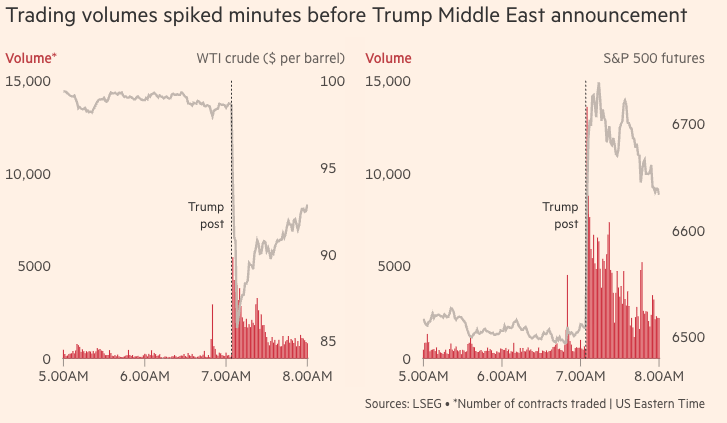
Source: Financial Times
$580m oil bet placed just before Trump post. Just 15 minutes before US President Donald Trump flagged “productive conversations” with Iran on Truth Social, an unknown trader placed US$580m worth of oil futures trades.
The post sent oil prices lower as markets began pricing in a shorter Middle East conflict than expected. The timing has raised eyebrows, with one US market strategist noting, “You have to wonder who was aggressively selling futures just 15 minutes before Trump’s post.” (FT)
A message from Australian Property Scout

Australian Property Scout’s books are officially open, which means investors now have the opportunity to connect with the APS team and explore what the next stage of their property journey could look like.
On a discovery call, our strategists will walk you through the APS approach — how we identify high-quality opportunities, structure portfolios for long-term growth, and help investors build with clarity and confidence.
If you’re serious about building or scaling your property portfolio and want to understand the strategy behind it all, this is your chance to speak with one of our team and see whether APS is the right fit for you.
Today’s Insight
What is Quantitative Investing with Dr. Dave Allen
This was taken from our recent Equity Mates Investing episode titled ‘The Data Signals that Predict Winning (and Losing) Stocks with Dr. David Allen’ (Spotify | Apple | YouTube)
Ren: Quantitative investing is kind of like a catchall term now for a number of different systematic trading strategies and you would do things very different to some of your peers. So how do you define your investment process and how is it different to some of the other ones?
Dave: It's a really good question because Quantitative investing is a broad spectrum of really diverse strategies. At one end, there's the high frequency guys where your trading times is measured in milliseconds, medium term frequency is minutes. And there's also the quantitative approaches that are purely black boxes. So you feed in this vast quantity of data and it says, buy this, sell this. Not even the people who build these models know actually why. They're not tractable. They really are the very epitome of a black box.
Our approach is much more, they call it Quantum mental, which is a strange term, but all it really means is it's traditional fundamental investing, but heavily systematised and automated. A traditional fundamental manager, if they're absolutely working their socks off, they're visiting companies, they are speaking with management every day, they are pouring through the financials. If you are absolutely working your guts at, you might be able to cover 20, 25 companies. So you've got very limited bandwidth. Our approach, because we've really taken traditional fundamental tools that work, so we've got 16 different valuation models, we've got 150 red flags, we have dozens of ways of measuring sentiment, but we've systematised it. So our bandwidth, rather than just being 20, 25, is almost 20,000 companies. And we can maintain an exceptionally high hitch rate even out to that very broad level. And what that means is that our typical position size is pretty conservative, hundreds and hundreds of positions on the long side, hundreds of positions on the short side. So whenever we do get them wrong, at which we of course will, that doesn't even necessarily mean we'll have a bad day, week or month.
Today in Equity Mates
Today on Equity Mates Investing we break down our own Gas Tax proposal, Telix Pharmaceuticals is pitched for our community portfolio and we get the latest on Australian property prices with Sam Gordon from Australian Property Scout. Check out the episode in the following links. (Spotify | Apple | YouTube)